Welcome to my Blog

I am a semi-retired former Scottish trade union policy wonk, now working on a range of projects. This includes the Director of the Jimmy Reid Foundation. All views are my own, not any of the organisations I work with. You can also follow me on Twitter. Or on Threads @davewatson1683. I hope you find this blog interesting and I would welcome your comments.

Tuesday, 24 May 2016

Prospects for education services in Scotland

Giving the Deputy First Minister responsibility for education is meant to send a message that this service is a priority for the new government. So what might we expect in the coming years?

Let's start at the beginning, with early years. The SNP manifesto commitment is:
"By 2021, we will almost double the availability of free early learning and childcare to 30 hours a week for all 3 and 4 year olds and vulnerable 2 year olds – a policy that will save families over £3,000 per child per year. To deliver this expansion, we will invest an additional £500 million a year by 2021 and create 600 new early learning and childcare centres, with 20,000 more qualified staff."

By any standards this is a big and welcome commitment, even over a five year period. The first delivery challenge is budgetary. Is £500m really enough to pay for 600 new centres and 20,000 staff? By my calculations this will barely cover the cost of employing qualified staff at todays pay rates. Then you have the capital and revenue costs of the new buildings, which is difficult to calculate, but will be huge. Perhaps it's a good thing the former finance cabinet secretary is now running education - he will need to do the 'loaves and fishes' miracle with this one!

What the manifesto doesn't say is how and who will be delivering this massive expansion. As the UNISON Scotland early years manifesto sets out, this is best delivered as a public service with fairly paid staff. Working with children is not just about the time spent with each child. Workers also have to plan, evaluate, and assess learning and keep detailed records of each child’s progress. There needs to be wider recognition of what these posts involve and adequate funding for the staffing levels and hours of work required to do the job.

Schools and closing the attainment gap is the next challenge. There has been some ridicule from opposition parties over John Swinney’s call for some time, given they have been in power for nine years. However, he does at least bring a fresh pair of eyes to the challenge and as UNISON has pointed out in our submission on the Education Bill, the attainment gap is rooted in our unequal society, not simply what happens in schools.

The specific proposals in the SNP manifesto have a very Tory/New Labour feel about them - testing, targets, and funding directly to schools bypassing local authorities. Sadly, there is little evidence that these approaches have worked elsewhere and it is noticeable that the advocates of academies and free schools in England are now calling for larger groupings of schools, as large as 25 schools. That looks remarkably like a local educational authority to me!

What is sensible is the plan to renew the focus on literacy, numeracy, health and well-being – targeting support on areas with significant areas of deprivation. Investing £750m ‘in the next parliament’ in the Attainment Fund and £100m from the Council Tax changes will be welcome - even if the extra bureaucracy of head teachers having to administer it isn’t.  There is also a welcome recognition that teacher numbers are not the only solution – classroom assistants get a mention after years of cuts. School libraries also deserve greater recognition.

The biggest structural change is the proposal to create ‘new educational regions to decentralise management and support’. That sounds like tautology to me, but we can only assume it means regionalising education authorities, while allocating more resources directly to schools. This will be backed up by ‘more focused and frequent’ school inspections.

The next stage in the education journey is colleges. After years of cuts, regionalisation and 2000 job losses; the commitment is to, ‘maintain the number of full-time equivalent college places that lead to employment’. There is an understandable view in the sector that they have paid the price for extra university funding. However, there should at least be a bit of stability going forward.

For universities the focus is on improving access for students from the most deprived backgrounds. Free tuition is the right policy and enjoys cross party support, but it has done little to improve access. They will adopt the recommendations of the Widening Access Commission and set a new target of 20 per cent of students entering university to be from Scotland’s 20 per cent most deprived backgrounds by 2030. Reviewing bursary support for students in colleges and universities will be an important part of achieving that target.


It is pretty clear that the new government’s education focus is on early years and schools. Educational inequality starts young, certainly before school age, so that is the right priority. The row over the Named Person scheme is frankly a distraction from more important issues. The big challenges will be financial, particularly in early years where the ambition doesn’t match the budget. In schools there will be significant scepticism that the outlined structural reform will contribute to the solutions, but targeting additional funds where it is most needed, is the right approach. 

Tuesday, 17 May 2016

The prospects for NHS Scotland and health policy

Improving the health of people living in Scotland ought to be a high priority for any government – so what might we expect from the next Scottish Parliament session?

Health inequalities remain Scotland’s most enduring problem as this week's GCHP report shows yet again. Life expectancy between the wealthiest and poorest areas remains stubbornly high. The SNP manifesto included a brief mention of health inequalities and that in the context of public health, with the promise of a new strategy on diet and obesity. Of much greater significance will be commitments to new housing and income support through devolved welfare powers. However, these measures will be constrained by the impact of austerity on public spending in Scotland and the limited use of new taxation powers.

One of the few SNP manifesto spending commitments is an increase in the NHS revenue budget by £500m ‘by the end of this parliament’. This is a modest increase over five years that should be funded from the Barnett consequential of English NHS spending. 

As we will be relying on these Barnett consequentials, we should take a closer interest in what is happening south of the border. Professor Andrew Street at the University of York points out that the claimed £8.4bn increase in English spending by 2020-21 is actually closer to £4.5bn. The chart below shows how this spending might be increased each year and the average 0.8% looks very low. The modest £500m increase promised for NHS Scotland therefore looks like John Swinney’s pragmatic assessment of the Barnet consequentials.


NHS England has highlighted a £30bn spending gap by 2020/21, of which the UK government claims to be providing £8bn. Wage and drug costs; a growing and ageing population; and a trend in activity demand, over and above the demographics, explains the gap. There are similar pressures in Scotland. Even if our population growth is slower than England, we have an older population and poorer health that drives up costs. NHS England’s ‘Five Year Forward View’ has some pretty optimistic solutions, including ‘a radical upgrade in prevention and public health’ and a shift to primary care.

It is not even clear that the Barnett consequentials will reach actual health board budgets, which are already under pressure. The SNP manifesto unhelpfully compounds the annual increase and claims it totals £2bn over the parliament. However, they are also committed to investing £1.3bn ‘from the NHS to integrated partnerships to build up social care capacity’. It is unclear if that is over and above the NHS revenue increase. It wasn’t in this year’s budget and it is hard to see where else this money is going to come from. 

As councils deliver social care, this is a big dent in the NHS spend, although few would dispute the priority given to social care that is in a state of crisis and the need to end the waste in bed blocking.  It will also help pay for the commitment to pay the living wage - an important first step in improving the recruitment and retention of staff in the sector. 

There are some other specific spending commitments. £150m has been identified for mental health services. This is welcome and there were similar commitments in all the party manifestos; demonstrating that the underfunding of these services, particularly for children, has attracted everyone’s attention. There is also £200m for five elective treatment services, although the adequacy of that budget has been questioned and it is a suspiciously round number!

The number of staff working for NHS Scotland recovered to its pre-crash levels last year and is likely to grow again. There is a commitment to an extra 500 health visitors, training for an additional 500 advanced nurse practitioners, 250 Community Link Workers and 1000 paramedics ‘working in the community’. There will be another 100 GP training places and £23m to increase the number of medical school places. Extra staff on the establishment will be welcome, but given the number of vacancies at present, it may be some time before actual bodies appear on the ground.

As in England, the Scottish Government is looking to reform to plug at least some of the financial gap. The SNP manifesto says “The number, structure and regulation of health boards – and their relationships with local councils – will be reviewed, with a view to reducing unnecessary backroom duplication and removing structural impediments to better care”.

Reducing the number of health boards is a practical proposition when it comes to acute services and could be built around three or four major trauma centres. It is much more challenging when it comes to community services. 

It is here that much will be expected from the new Integrated Joint Boards and it remains to be seen if these will continue as joint boards or morph into stand alone bodies. That will probably depend on how successful they are. Another option, as happens in other parts of Europe, is to move these services into local government. That option is unlikely in Scotland given the Scottish Government’s antipathy towards councils. The next GP contract could also be an opportunity to reform the antiquated small-business model, into something that is more integrated into the NHS or the IJBs.

What seems clear, is that the additional NHS staff and investment in social care are primarily focused on achieving what the SNP manifesto describes as “ensuring that our NHS develops as a Community Health Service”. Few would argue with that priority, as shifting resources from acute to primary care makes absolute sense. However, it has been an objective of many different governments over the years, in less challenging financial circumstances.

This is of course a minority government, but despite regular squabbling in parliament, there is a large degree of political consensus over health. Even the Tories are not immune from that consensus with little evidence of the market ideology that drives their counterparts in England. Labour and the Greens both put greater emphasis on tackling health inequalities and that also requires a shift from acute to preventative primary care services. If there is a difference in approach, it is structural - the opposition parties have a common preference for localism over centralisation.

On this basis, there appears to be a common understanding of the problems. The challenge remains to deliver the solutions in the context of austerity.

Friday, 13 May 2016

Change in public services

Public service reform could be one of the defining issues of the coming Scottish Parliament session.

I was speaking at the 'Leading Change in Public Services' conference at Queen Margaret University in Edinburgh today. An international gathering of academics and practitioners on this issue. There is some very interesting academic work being done on this issue across Europe that should inform our debate. My task was to set the scene by outlining public service reform so far in Scotland, likely new directions and some alternative approaches.

The challenges is the easy bit to describe. Public services are being savaged by austerity economics, and in Scotland, has largely been dumped on local government services. The chart below demonstrates this in financial terms.


The workforce numbers show this even more dramatically. A staggering 87% of the public sector job losses in Scotland since the crash have been in local government.

Job losses and finance are the biggest challenges, but not the only ones. We also have demographic change that is increasing demand on council services, particularly social care. Poor economic performance is also increasing demand as is the need for public services to respond to climate change. However, underpinning all this is Scotland's deep seated inequalities. As the Christie Commission highlighted five years ago, failure demand accounts for around 40% of public spending in Scotland. 

The financial pressures are likely to get worse. There is about another £1.5bn of revenue cuts to come for Scotland in the current UK spending plans. The Scottish Government is not planning to use many of the new powers to take Scotland in a different direction to austerity. The tweaks to the higher rate tax bands and the Council Tax will mitigate the cuts by around £350m less £60m cost of cutting APD, unless as I hope, the opposition parties combine to stop this. Given the NHS spending commitments, it seems pretty clear that local government (less perhaps education) will continue to bear the brunt of cuts.

Apart from job losses, the impact on the workforce can be seen in UNISON Scotland's monthly 'Damage Series' of reports. Almost all staff groups comment on the salami slicing of services, the juggling of plates to the extent that many of them are now crashing. Just doing the statutory minimum, and often not even that, while abandoning much of the preventative work that they value and is so important if we are to tackle long term problems. It shows up in sickness absence, particularly stress and violence, and in a demoralised workforce with declining morale. We should also pay more attention to the ageing workforce and the lack of young people coming into public service.

Five years ago I was working on the Christie Commission report. It called for services to be designed from the bottom up with greater user involvement. The report argued for preventative spending and a focus on outcomes. It also called for more integrated working, breaking down the silos and even going as far as looking at the 'one public sector worker' concept.

While almost everyone agreed with the principles set out in the report, delivery has been mixed, as I set out in an article last year. While the essential Scottish public service model remains intact, we have greater centralisation, ministerial direction and a new approach of quangos directing policy, even when delivery remains local. In my experience, the longer ministers are in office, the stronger the temptation is to direct services from the centre, reinforced by the civil service culture.

The SNP manifesto points to a programme for the new government that envisages significant structural change. Reviews are promised of the structure of health boards and councils. New regional education bodies with more finance going directly to schools. There are also proposals to allow community councils to run some services and 1% of council budgets devoted to community budgeting. 

This could lead to fewer health boards, which might work for acute services, but not for primary care. Of course they are subject to the new integrated joint boards with social care. If this form of joint working doesn't deliver greater joined up working, then the pressure to make them formal structures and the employer of staff will grow.

With education and social work going elsewhere, leisure and housing has already largely gone arms length, you are left with rump local authorities. They could be left to wither on the vine or merged, with decentralisation schemes that give communities a larger say in how the few services that remain are delivered. 

Structural change is notoriously difficult and expensive. Organisations go into limbo while preparing for it and then spend years sorting out the new bodies. In the current financial climate it could be argued that is simply analogous to shifting the deck chairs on the Titanic. 

At today's conference I didn't offer a prescription for a different approach, but I did suggest some principles that we might consider in the debate to come. 

First and foremost, we should not simply roll over and accept austerity economics. Public services play an important role in tackling inequality, in part, as the OECD has observed, by mitigating the gross income inequality in the UK. We should recognise the value of proportionate universalism while targeting resources on preventative spending.

While centralisation is not the answer, that doesn't mean that in a small country there isn't a case for national frameworks. These could set out common standards, data sets and proportionate scrutiny. In particular, UNISON has long argued the case for a national workforce framework that would include common staff governance standards, training and start to break down the silos and make it easier for staff to move between services. I am personally increasing attracted to a longer term goal of the one public service worker with common terms and conditions, although I recognise that this has its challenges. Apart from facilitating integration, it would also reducing the significant costs associated with constantly reinventing the HR wheel.

Having national frameworks then enables greater localism, freeing up local democracy to focus on integrated service delivery rather than fragmenting services on the outsourced English model. This could be based around real communities; towns and discreet urban areas, with community hubs providing a base for most public service delivery. Services can then be designed with service users and staff, adopting system thinking principles, rather than the dead hand of the one size fits all approach.

Austerity may be the defining feature of public service delivery in Scotland, but we shouldn't let it define the sort of Scotland that we want. Public services play a central role in that vision and it is right that we take a considered look at how they are best delivered.


Sunday, 8 May 2016

Scottish Labour - What Next?

As you would expect after last week’s election result, there is no shortage of analysis of Scottish Labour’s problems – even if that commentary is stronger on the problem than the solution.

My own contribution can be found in my column in today’s Sunday Mail. I am in not ducking the deep-seated problems, but Labour’s policy stance at this election puts it in a stronger position as austerity bites even harder. Making a radical change of direction or leadership is not the way forward. Sometimes in politics you have to play a longer game. Brian Wilson in the Sunday Times also takes a positive view.

If there is any point to John McTernan, it is to articulate another failed strategy - something he has considerable experience of. And he doesn’t let us down with his three points in yesterday’s Scotsman. So let’s address them because they do represent a strand New Labour opinion that believes that Labour must do whatever works, and if that means out Torying the Tories, then so be it.

Firstly, Labour should be the fundamentalist unionist party. This strategy may have shifted the voting share a couple of points in this election, but in the longer term it’s a dead end game. With the ‘No’ vote split three ways, Labour has little chance of getting more than a quarter of the vote - forever fighting with the Tories over the dubious prize of being the largest opposition party. It’s fine for the Tories who just want to conserve the status quo, but we are a socialist party, committed to changing our unequal society.

Secondly, Labour should not have outflanked the SNP on the left with the taxation policy. In essence this means conniving with the SNP’s Scandamerica myth that we can have social justice without cost. An SNP-lite policy stance would have left Labour without a distinctive policy offer. The polls showed clearly that Labour’s policy was more popular with SNP voters than their own manifesto offer and that points to a longer-term strategy.

Thirdly, ‘the unions self-indulgently imposed an anti-Trident policy of Kezia Dugdale’. Factually wrong because the policy was supported by constituencies as well as unions and reflects a long-standing view within Scottish Labour on this issue. Historically, that may have reflected a moral stance on nuclear weapons, but today, just as many members see the folly of spending £167bn on a militarily useless weapons system.

An interesting view, from outwith Scotland, comes from PaulMason. His solutions focus primarily on the UK party, but he has some useful points on Scotland as well. Like many English lefties he retains a romantic view of Scottish nationalism and an optimistic view of the prospects for independence. None the less, he has a point about how Jeremy Corbyn needs to get a grip of UK party organisation and reorganise it as a federal party. Politically, this is reflected in the latest Red Paper publication and organisationally, in my own paper. There is already a rather poor UK party discussion paper on this issue and there will shortly be a consultation amongst Scottish Labour Party members.

I am not sure Kevin McKenna’s ‘bring it on’ strategy over an independence referendum will work. Even though I was one of the few that supported Wendy Alexander. It was a strategy of its time, like the second question that the unions also championed. It was an opportunity missed, like so many, due to the complacent Labour Westminster establishment of the period. The problem with a quick re-run of Indyref is that neither side has moved on. It would again be Project Fear vs Project Pollyanna, with Project Fear having fresh economic ammunition post the oil price crash, but with even less vision of how a fairer Scotland can be achieved. On the other side, the independence project remains a disparate political alliance, with little work completed on the issues that need to be addressed before a clear majority of Scots will vote for it.


In conclusion, I’m afraid I don’t have a magic wand for Scottish Labour’s challenges. However, I do believe that the rebuilding project that started some nine months ago has to continue with renewed effort. Scottish Labour now at least stands for something worthwhile. It will take time to get a hearing, but lurching in a new direction will only hamper progress.  


Friday, 29 April 2016

Fracking and the election debate

Fracking has probably been the only energy issue to surface in the Scottish Parliament election campaign. The Tories support it, Labour oppose it, and the SNP are sceptical, but not ruling it out.

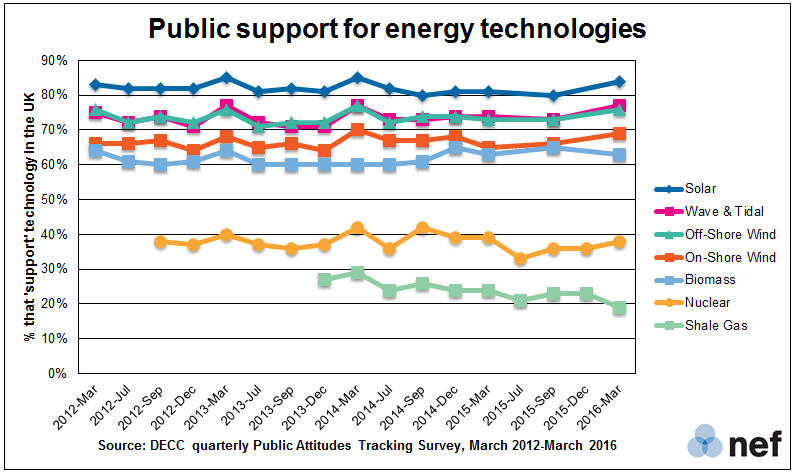
As we have previously reported, the energy minister Fergus Ewing is clearly pro-fracking, but we suspect Nicola Sturgeon is more sceptical - either from conviction or political judgement. If it's the latter she might want to read the latest Department of Energy and Climate Change (DECC) public survey about their views on different energy types and how they use energy in their daily lives. The headlines show 81% of the public support renewable energy, with over a third “strongly” supporting it. Only 19% support fracking.

image

We suspect the pro-fracking lobby promoted the story that the First Minister was going to sack or shift Fergus Ewing after the election. A pre-emptive strike to keep their man in place. Their concern appears justified when you read the SNP manifesto, which is significantly more fracking sceptical than Scottish Government language to date. It says:

"We are deeply sceptical about fracking and have ensured that no fracking can take place in Scotland by putting in place a moratorium. We have also put in place a very thorough research process and plans for a public consultation so that any decision is based on both evidence and public opinion. Unless it can be proven beyond any doubt that there is no risk to health, communities or the environment, there will be no fracking or UCG extraction in Scotland."

This 'beyond any doubt' position is probably closer to the views of most SNP candidates, particularly those in the central belt fracking zone. There have been several 'no shows' by SNP candidates at hustings on this issue. Ineos continue to suggest that they expect fracking to be approved - pretty unhelpful to the First Minister who continues to refuse to release a full version of her meeting with the company.

The pro-fracking lobby will have been encouraged by a paper written by Professor Younger from Glasgow University who says that there is no risk to water supplies from fracking. On the other hand, The Ferret reports that studies in the USA show just how fracking has contaminated water supplies.

Whatever the outcome of environmental studies, the Scottish Labour manifesto has the right approach by focusing on climate change grounds, it says:

"It is because of the need to tackle climate change that we will ban fracking in Scotland. The science is very clear that the last thing we need is to burn another fossil fuel. Rather than a temporary freeze, or studies which report a few years down the line, our position is very clear — no I fs, no buts, no fracking under Labour."

This position is reinforced by an authoritative new study from the US Environmental Protection Agency which says fracking is set to lead to a sharp rise in emissions of climate changing greenhouse gases. This undermines industry and government claims that shale gas is a relatively clean fuel that can help combat global warming.

So, the environment case for or against fracking remains in doubt, which makes it difficult for the industry to meet the new, more sceptical, SNP manifesto position. The climate change argument against fracking remains strong and many analysts still doubt it's economic viability at current gas prices. The public are clearly with Labour on this one - no ifs, no buts, no fracking.


This content was first posted at Utilities Scotland

Thursday, 28 April 2016

International Workers Memorial Day


Today is International Workers Memorial Day. When we go home to our loved ones tonight, we should remember the twenty Scottish workers last year, three a week across the UK, who didn’t make it home to their families because they died at work.


Deaths at work are only the tip of the iceberg. Many thousands die as a result of illness they contracted at work. While we don’t have precise figures, it is a fair assumption that since the Second World War, more people have died as a result of their work than in military combat.


And it isn’t only deaths. 1.2 million workers suffered from work related illness last year – from long-standing causes such as exposure to chemicals, to the mental health pressures modern work techniques are placing on many workers. As UNISON’s annual violence at work survey shows, more than 30,000 public service workers in Scotland reported violent incidents last year. Yet we still have some employers who think violence is part of the job.


IWMD is also an opportunity for us to focus on health and safety as trade unions. It should be a core part of what we all do and shouldn’t be left to a few specialists. That’s why we make a special effort today to undertake safety inspections that make our workplaces safer. Something the UK Government seeks to undermine in the Trade Union Bill.


Health and safety is also under direct threat from government policy. The HSE budget is being cut in half by 2020, making enforcement the exception rather than the rule. The same applies to council environmental health departments, whose statutory safety functions have been significantly reduced. The UK Government has also pursued a de-regulation agenda that dismisses health and safety as ‘red tape’. As in so many policy areas, this government’s priority is always to put profit first and the workers are simply expendable.


Wider public service cuts and job losses put extra pressures on the remaining staff, with the temptation to cut corners an ever present risk. Not to mention the physical and mental health toll it takes out of the workforce.


This year there is an inevitable focus on Europe. A new TUC report finds that EU legislation has helped stop illnesses and injuries at work, and saved lives. Much of the health & safety law in the UK is now underpinned by the EU, with almost two-thirds (63%) of new British health & safety regulations introduced between 1997-2009 originating in Europe (41 out of 65 laws). The biggest cheerleaders for Brexit see protections for workers, like health and safety, as just red tape to be binned.


So especially today, let’s remember the dead, but also fight for the living.

UNISON Scotland staff in Glasgow gather to mark IWMD.

Tuesday, 26 April 2016

Chernobyl 30 years on and the future of nuclear power

Today is the 30th anniversary of the Chernobyl disaster, when an uncontrolled reaction blew the roof off, spewing out a cloud of radioactive material which drifted across a swathe of Northern Europe. The contamination reached as far as Scotland and remained until 2010.

Levels of radioactivity remain high in the surrounding area. A charity, Bridges to Belarus, is warning that a number of babies in a region close to Ukraine's border are still being born with serious deformities, while an unusually high rate of people have rare forms of cancer. Ukraine is not a country with its problems to seek and it is here that the impact remains the greatest. A World Health Organisation investigation suggests that populations exposed to the radioactive fallout may still be struggling with a number of health problems, including cataracts, pulmonary disease and congenital disorders.

The psychological impact is equally great and many have fallen back on fiction and black humour. A joke the workers on site share, which is based on the remotely-controlled robots initially used to clear the irradiated graphite from the exploded reactor’s roof – until the radiation rendered them unresponsive. It runs: “An American robot is on the roof for five minutes, then it breaks down. The Russian robot is up there for two hours! Then a command comes in over the loudspeaker: ‘Private Ivanov! In two hours you’re welcome to come down and have a cigarette break!’”

Chernobyl has had an impact on the development on nuclear power as an energy source. Safety systems are undoubtedly much stronger, but it is also a less prevalent energy source than once expected. Germany has abandoned nuclear and others are less reliant on it.

In the UK the replacement programme is moving at snails pace. EDF, the French energy company promoting the £18bn reactor scheme at Hinkley, has admitted there would be no final investment decision at least till the summer. The French unions are concerned about the financial impact on the company and have invoked a consultation process. Hinkley has attracted criticism in the UK from a range of sources, including the City and environmental groups, as an overly-expensive project. The government has promised to pay £92.50 per megawatt hour for the power over 35 years - double the current cost.

In Scotland we are still heavily dependent on nuclear power from Hunterston and Torness as a source of base load electricity. One third of our electricity generation comes from these two plants, which operate even when the wind doesn't blow and the sun stops shining. Even the anti-nuclear Scottish Government has not opposed life extensions to both plants.

Those who argue that there is a case for replacing at least one nuclear plant recognise it isn't going to happen. If Hinkley is struggling to get off the ground in a benign political environment, there is no prospect of a company investing in Scotland. There is a certain irony that a dirty energy source such as fracking has more support amongst Scottish ministers.

Given the complexity and costs associated with a conventional nuclear power station, many in the industry are investing their hopes in mini-reactors. The U.K. Government wants to be a “global leader in innovative nuclear technologies”. Part of this plan involves spending £250m on a research and development programme to put the UK in with a chance of "winning” the race to develop small modular reactors (SMR).

SMR's are essentially scaled down reactors that generate around a third of the output from a current nuclear power station, or 10% of that planned at Hinkley. That's enough power for 1 million people all the year around, compared to the 26% output from the best wind turbines that supply less than 10,000 people.

The main advantage is probably smaller start up costs, making it a less risky investment. They can be built centrally and moved to the site. Smaller output is easier to manage on the grid and they have good safety features including an underground cooling system that makes Japanese style core meltdown unlikely. The main drawback is the increased running costs. Each kilowatt hour (kWh) of electricity from an SMR would be expected to cost between 15% and 70% more than a kWh of electricity produced in a full-sized nuclear power station, due to economies of scale.

SMRs are being built in China, India and Russia and the UK government's competition should deliver progress in the UK. On the other hand, we all remember the shambles of the CSS competition, which dragged on for years and was then abandoned.

So, on the 30th anniversary of Chernobyl we should remember the human cost of that tragedy that continues to this day. However, safety is probably the least concern with a new generation of reactors - financial cost is a much larger issue. SMRs may offer a cost effective alternative source of base load generation, but don't expect to see any in Scotland soon.